Ian Matthew Miller
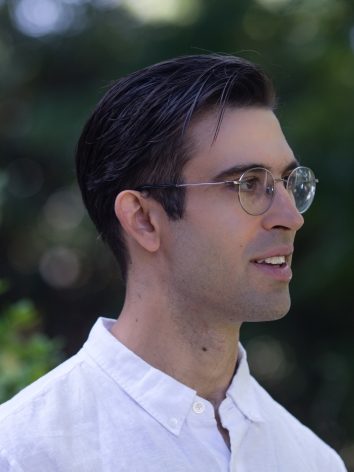
Primary Investigator
Associate Professor of History and Director of Asian Studies, St. John’s University
Ian M. Miller is a historian of how human ideas and behaviors become physical landscapes. An associate professor of history and program director of Asian Studies at St. John’s University, he studies forests, villages, and the institutions that quietly organized them over centuries. He is the author of Fir and Empire and co-editor of The Cultivated Forest. His current book, Ancestral Shade, traces how fengshui and lineage organization shaped patterns of settlement, burial, and environmental management in late imperial China. His work treats the environment not as the background or container for human action, but as a historical record of social choices.
Christopher Reed Coggins
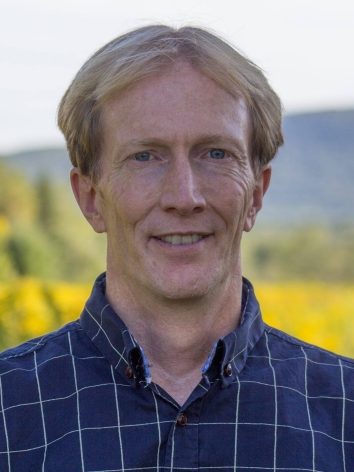
Ecology Group Head
Professor of Geography and Asian Studies, Simon’s Rock College at Bard
Christopher Coggins is a professor of Geography and Asian Studies at Bard College. He is the co-editor (with Bixia Chen) of Sacred Forests of Asia: Spiritual Ecology and the Politics of Nature Conservation (Routledge/Earthscan, 2022), and the co-editor (with Emily Yeh) of Mapping Shangrila: Contested Landscapes of the Sino-Tibetan Borderlands (U. Washington, 2014). He is the author of The Tiger and the Pangolin: Nature, Culture, and Conservation in China (U. Hawaii Press, 2003) (runner-up for the 2003 Julian Steward Award for best book in environmental/ecological anthropology; nominated for the Kiriyama Prize in non-fiction). He is currently co-editing The SAGE Handbook on China’s Environment (with Yifei Li) and a book on China’s fengshui forests. He has published numerous refereed articles and chapters in geography, history, environmental studies, and Asia-related books and journals. In 2019, he was selected to serve for three years as one of fourteen scholars on the ASIANetwork Speakers Bureau.
Xin Yu
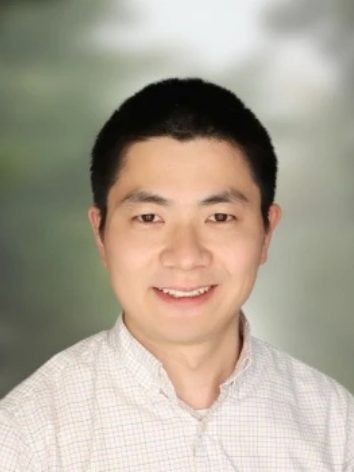
Documents Group Head
Assistant Professor of History, University of Wisconsin, Milwaukee
Xin Yu (余欣) is an Assistant Professor in the History Department at University of Wisconsin-Milwaukee. His research interests include late imperial Chinese history, book history, and history of the family. His first book project, which is based on his doctoral dissertation “Publishing at the Grassroots: Print Culture and Rural Society in Early Modern China” (Washington University in St. Louis, 2022), surveys the history of Chinese genealogies between 1450 and 1644. Genealogies were large compilations of family-related texts and images. They started to be popular around 1500 and became possibly the most widespread type of books in the nineteenth and early-twentieth centuries. He found that the proliferation of genealogies was both a product of and a catalyst for the development of lineage organizations (large-scale patrilineal organizations that performed multiple functions) in southern China. It was also a process in which book and print culture started to penetrate rural society, reaching both the literate and illiterate populations at the bottom of Chinese society.
Ye Hua

Case Studies Group Head
PhD candidate, Hong Kong Institute for the Humanities and Social Sciences, The University of Hong Kong
Ye Hua (華燁) is a PhD candidate at the Hong Kong Institute for the Humanities and Social Sciences, University of Hong Kong and a predoctoral fellow at the Max Planck Institute for the History of Science. She earned her bachelor’s and master’s degrees in Chinese history from Fudan University. Her dissertation investigates the rise of geographic physiognomy (xiangdishu 相地術) in southern China, a branch of Chinese geomantic knowledge that interprets mountain and river topographies to shape human fortune, from the 12th to the 18th century. Focusing on the interactions between state and society, the study traces how embodied expertise—rooted in direct engagement with the southern mountainous landscape—developed into a widely accepted technology for sustaining social order and regulating daily life. Ye’s broader research examines Chinese cosmology and its visual and material expressions in everyday practice.
Min Lee

Ethnography Specialist
PhD Candidate, UC Berkeley-UC San Francisco Joint Program in Medical Anthropology, University of California at Berkeley
Min Lee (李旻) is a PhD Candidate in the Joint UC Berkeley and UC San Francisco Medical Anthropology program at the University of California, Berkeley. Her research engages with interdisciplinary studies of the good life, situated at the intersection of food and agriculture studies, migration studies, and medical anthropology, with a regional focus on contemporary China. Her doctoral dissertation, Life Taking Root: New Villagers Seeking Experimental Life Migration in Southwest China explores how young and educated urban-to-rural migrants in Southwest China experiment with ethically and politically “sustainable” life.
Yiyang Jiang
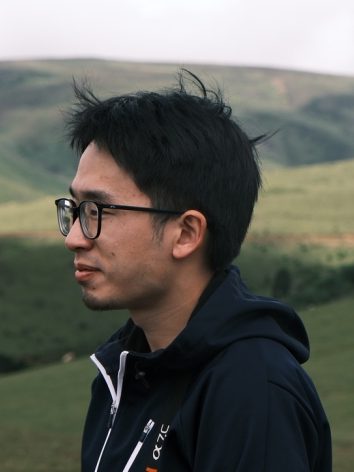
Local Relationship Coordinator
Masters Candidate, University of Michigan
Yiyang Jiang (江奕旸) is a master’s candidate at the University of Michigan. His research encompasses the texts and rituals of folk beliefs (especially mountain spirits), as well as religious archives of the Republican period. As a historian deeply influenced by anthropology, his recent interests focus on the perception and imagination of the landscape, particularly how modern water conservancy—such as large-scale reservoirs, small ponds, and river channelization—has reshaped both. A native of Wuyuan, his four years of fieldwork experience in the region allow him to serve as a bridge between the research team and the local community.
 Village Landscape Lab, Wuyuan 婺源鄉野實驗室