Village Landscape Lab, Wuyuan
婺源鄉野實驗室
Village Landscape Lab is an interdisciplinary research and teaching initiative dedicated to documenting and understanding China’s village landscapes as living socio-ecological systems. Focusing on historic settlements in Wuyuan County, Jiangxi, the project brings together historians, geographers, anthropologists, and local experts to study how villages were shaped over centuries by lineage institutions, ritual practice, infrastructure, and the management of land, water, and forests.
Through integrated fieldwork combining historical texts, ecological surveys, oral history, GIS mapping, and immersive media the Lab reconstructs how human and non-human worlds have co-evolved at the village scale. Our work supports new approaches to teaching Chinese history and ecology from the ground up, allowing students to explore landscapes as dynamic, contested, and historically embedded environments.
As rapid development transforms rural China, the Village Landscape Lab seeks to document, interpret, and learn from village systems before they disappear, offering tools for understanding resilience, sustainability, and change in the Anthropocene.
Why Wuyuan?
Wuyuan County, in northeastern Jiangxi, offers one of the rarest surviving windows into China’s long-term village landscapes. Unlike many regions where rural settlements have been erased or radically transformed, Wuyuan preserves an exceptional combination of textual depth, ecological continuity, and living institutions.
1. Unusually rich historical records
Wuyuan villages maintain dense collections of genealogies, land records, ritual texts, and other local writings that document centuries of decisions about land use, water control, burial, forestry, and settlement. These sources allow village-scale reconstruction of historical ecology with a level of detail rarely possible elsewhere.
2. Preserved landscapes and infrastructure
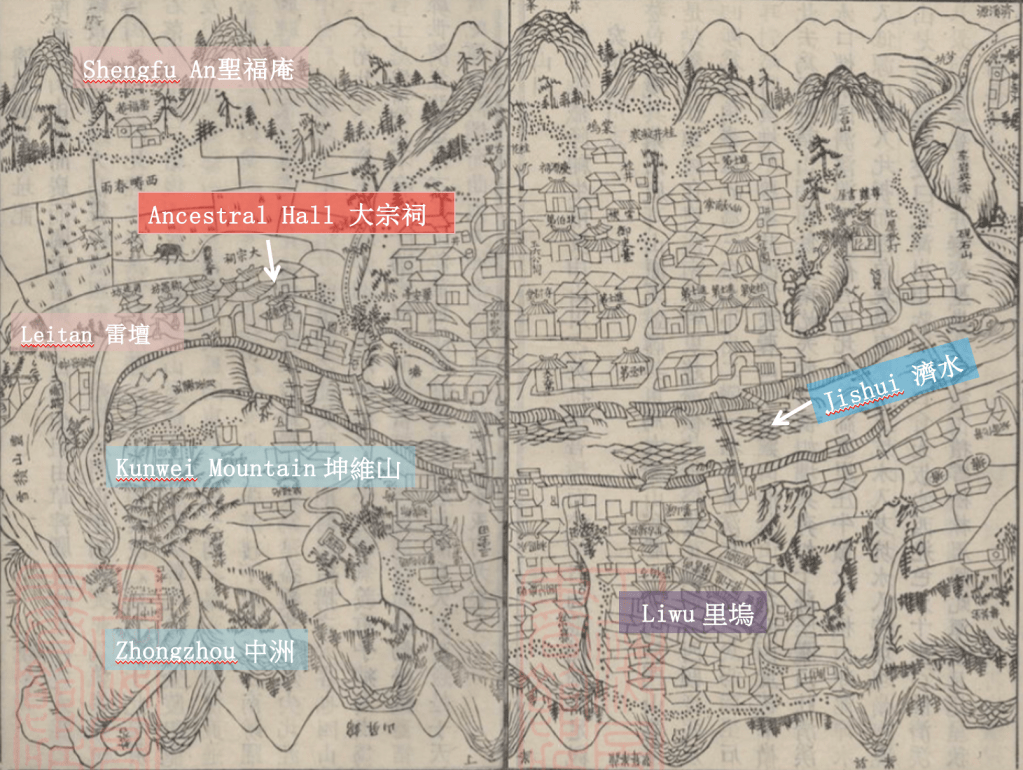
When compared to neighboring regions, Wuyuan’s irrigation works, ancestral halls, temples, forested hills, and geomantically significant sites remain unusually legible on the ground. In many cases, historical descriptions can be directly correlated with surviving physical features, enabling close integration of texts, maps, and field surveys.
3. Continuity of village institutions
Lineage organizations, ritual practices, and shared management of commons persisted in Wuyuan longer than in many neighboring regions. This continuity makes it possible to study how social institutions functioned as ecological actors, shaping landscapes over generations.
4. A natural laboratory of connected watersheds
Wuyuan’s villages are distributed across multiple river systems that link upland forests, agricultural valleys, and market towns. This makes the county an ideal site for studying socio-ecological networks, and how decisions in one village reshaped environments downstream.
5. A narrowing window of opportunity
Tourism development, depopulation, and infrastructure expansion are rapidly transforming Wuyuan’s rural landscapes. The county stands at a critical threshold: still legible as a historical system, but increasingly vulnerable to irreversible change.
Together, these features make Wuyuan uniquely suited for an integrated, village-level approach to Chinese historical ecology – one that treats landscapes not as static heritage sites, but as dynamic systems shaped by human choices over time.
Why Historical Ecology? Why the Village?
Large-scale histories often describe environmental change in terms of states, regions, or global systems. While these perspectives are essential, they can obscure how ecological change actually unfolded: through local decisions, institutional norms, and everyday interactions with land, water, flora, and fauna.
Historical ecology at the village level restores this missing scale. Villages were the primary units through which people organized labor, managed common resources, resolved conflicts, and embedded environmental knowledge in ritual, architecture, and landscape design. Decisions about irrigation, burial, forestry, and settlement were not abstract policies, they were negotiated locally and accumulated over generations, reshaping entire ecosystems.
A village-level approach also makes ecological history legible. Landscapes become readable as historical texts, where infrastructure, vegetation, and spatial taboos record past choices and constraints. This scale allows historians, geographers, ethnographers, and students alike to trace feedback loops between social institutions and environmental change. It reveals linkages and contingencies otherwise difficult to see from the top down.
By grounding historical ecology in villages, Village Landscape Lab offers a model for understanding long-term resilience and vulnerability. It shows how human societies have actively engineered their environments, and how those systems respond – sometimes creatively, sometimes catastrophically – to demographic pressure, climate variability, and economic transformation.
 Village Landscape Lab, Wuyuan 婺源鄉野實驗室